

Dental Implants in Long Island City, NY
Nature only gives you one set of permanent teeth. We're a little more forgiving than that.
The closest thing to getting your natural teeth back.
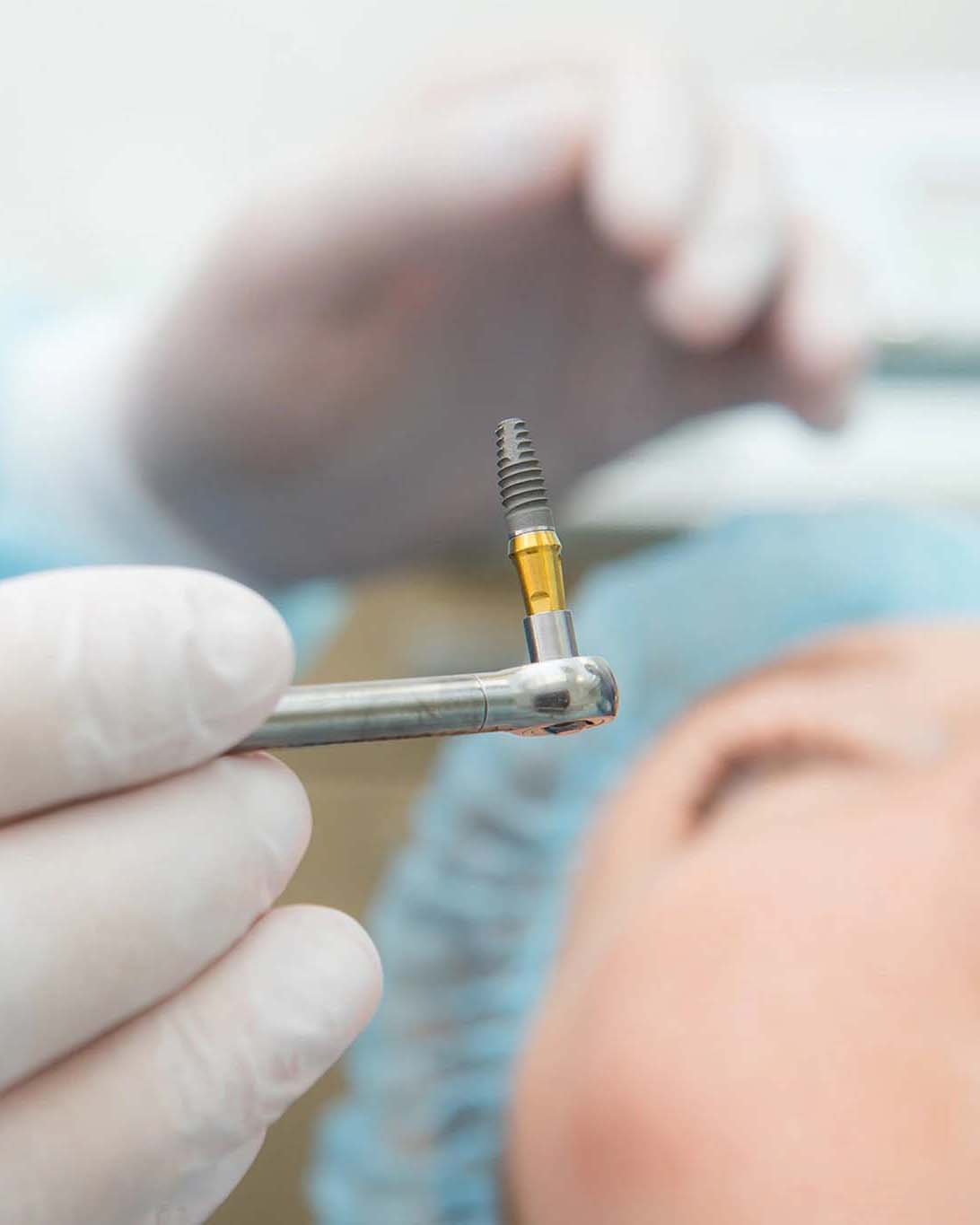
Dental implants are small, screw-like fixtures that serve as anchors to provide a stable foundation for replacement teeth such as crowns, bridges, or dentures. After being surgically placed into the jawbone, they fuse with the surrounding bone over several months in a process called osseointegration. Once restored, implants look, feel, and function like natural teeth, allowing you to eat, speak, and go about your life without thinking about them. At Gantry OMS, Dr. Miller handles the surgical component, placing each implant with precision and care; the final restoration is completed by your restorative dentist.
Types of Dental Implants
Single
This is a replacement for a single missing tooth. The implant acts as an artificial root, supporting a custom crown that matches your natural teeth in both function and appearance.
Multiple
For a span of multiple missing teeth, implants can be placed at either end of the gap to support a fixed bridge. This creates a stable, long-lasting solution that restores both aesthetics and chewing function.
Full-Arch
Depending on the plan prescribed by your dentist, multiple implants are strategically placed in the jaw to provide fixation for an overdenture, direct roundhouse bridge, or hybrid prosthetic ("AOX").
Remote Anchorage
When the upper jaw has lost too much bone volume to support conventional implants, specialized fixtures can be anchored in alternative sites such as the cheekbone or deeper jaw structures. This makes implant-supported teeth possible for patients who would otherwise not be candidates.
Have questions? We've got answers.
FAQs
Are same-day implants real, or is that just marketing hype?
Same-day implant placement is real, and for the right candidate, it's a legitimate option; the "teeth in a day" protocols you may have heard about (often marketed under names like All-on-X or All-on-4) refer to placing a full-jaw set of implants and a temporary fixed prosthesis in a single visit. This works well for patients who need most or all of their teeth replaced and have adequate bone to support it.
What "same-day" doesn't mean is that treatment is finished that day. The prosthesis placed at surgery is usually a temporary one; it allows you to function and look normal while the implants fuse with the bone over the following months (a process called osseointegration). Once healing is confirmed, typically around three months later, your restorative dentist fabricates the final, longer-term prosthesis.
For single teeth or smaller spans, same-day loading is less common. The placement surgery itself takes around 15-20 minutes per site, but most patients heal with a temporary or no restoration in that spot before the final crown or bridge is completed. Depending on healing progress and whether or not bone grafting was needed, completion of the process usually takes about three months.
At your consultation, Dr. Miller will let you know whether you're a candidate for a same-day approach and what timeline makes sense for your specific case.
Are dental implants painful?
Most patients are surprised by how manageable implant surgery is. As the area is fully numbed during the procedure, you may feel some gentle pressure and vibration, but not pain. Post-op discomfort is typically mild, and most patients find it considerably easier to recover from than a tooth extraction. Over-the-counter pain relievers are usually sufficient. For single implants, most patients return to normal activities within a day.
How long do dental implants last?
Dental implants are among the most durable tooth replacement options available. Pooled long-term studies show about 96% of implants still in place at 10 years, and roughly 90–93% at 20 years. Of course, these figures are averages, and the odds are somewhat lower for patients over 65 and for those who smoke or have diabetes.
The functional parts on top, whether a single crown, bridge, or full-arch prosthetic, generally do not last as long as the implant itself. Chipped porcelain, loose screws, and other repairs are common by the 10-year mark, so expect some maintenance or replacement of the restoration over time even when the implant itself is sound.
The main long-term threat is gum inflammation and bone loss around the implant, seen in roughly 1 in 5 patients over time. Regular professional cleanings and check-ups significantly reduce the risk of implant failure, particularly in patients with a history of gum disease. Your restorative dentist will guide you on caring for your specific prosthesis.
Who is a good candidate for dental implants?
Most people are good candidates for dental implants. Even patients with complicating factors like a history of smoking, diabetes, or bone loss are often still treatable with the right approach. Factors we consider include gum health, bone density, overall medical history, and any medications that might affect healing. At your consultation, Dr. Miller will review your records and imaging and give you a clear picture about what's possible for your specific situation.
What if I don't have enough bone for an implant?
Bone loss is common, especially if a tooth has been missing for a while or you've worn a denture for years, but it doesn't rule out implants. In most cases, the bone can be rebuilt through bone grafting, which adds volume and density where it's needed before (or sometimes at the same time as) implant placement. For more severe bone loss, there are also options that anchor implants into denser bone elsewhere in the jaw or skull, avoiding the need for grafting and the additional healing time that comes with it. These approaches are well established and often allow for a faster path to a functional set of teeth, even in cases where bone volume has been significantly compromised. If you've been told you're not a candidate for implants because of bone loss, it's worth getting a second opinion. Dr. Miller evaluates this with a CT scan at your consultation and can usually find a path forward, even in cases that have been turned down elsewhere.
Is an implant better than a bridge?
A dental bridge can replace a missing tooth without surgery and with a minimal time investment, which makes it appealing to some patients. The tradeoff is that a bridge requires crowning/capping the two teeth on either side of the gap, which are often healthy teeth that otherwise wouldn't need to be touched. It also doesn't address the bone loss that occurs when a tooth root is absent. An implant replaces the root itself, preserving the surrounding bone and leaving adjacent teeth untouched. For most patients who are good candidates, an implant is the more conservative long-term option despite involving a surgical procedure and a longer overall process.