Which specialist should treat your TMD?
One of the more frustrating things about being a patient with TMD is discovering how little the clinicians treating you seem to agree with each other. The internet is even worse, rife with confidently incorrect solutions. From bite guards and injections to physical therapy, massage, or whatever chiropractic adjustment or gadget is trending this month, there's clearly no shortage of treatments for this condition. Some work. Many are inappropriately applied.
The outcome of years of dogma
Some of that traces back to training. Very few practitioners outside of dentistry get anything more than an introductory primer on the TMJ. Even dental schools don't equip their students to manage a condition this complex, and general practice residencies rarely go any further. What fills the gap afterward is usually continuing education courses, and those are a mixed bag, often only as good as whoever happens to be lecturing that weekend. A lot of treatments still rest on outdated ideas about what causes TMD, and the therapies built on those ideas tend to be applied to every patient the same way, regardless of what's actually driving their pain (*coughBotoxcough*).
For decades, we oral & maxillofacial surgeons were the default referral for anything related to jaw mechanics. This was intuitive, as OMS residencies are the longest in dentistry, and TMJ management is a core competency in our training. Unfortunately, this may have led to aggressive treatments being dispensed before more conservative options had been tried. The same logic applies here as it does elsewhere in medicine: a meniscus tear in the knee doesn't always need an orthopedic surgeon before physical therapy gets a chance, and TMJ pain doesn't always need a maxillofacial surgeon right off the bat, either.
A better framework
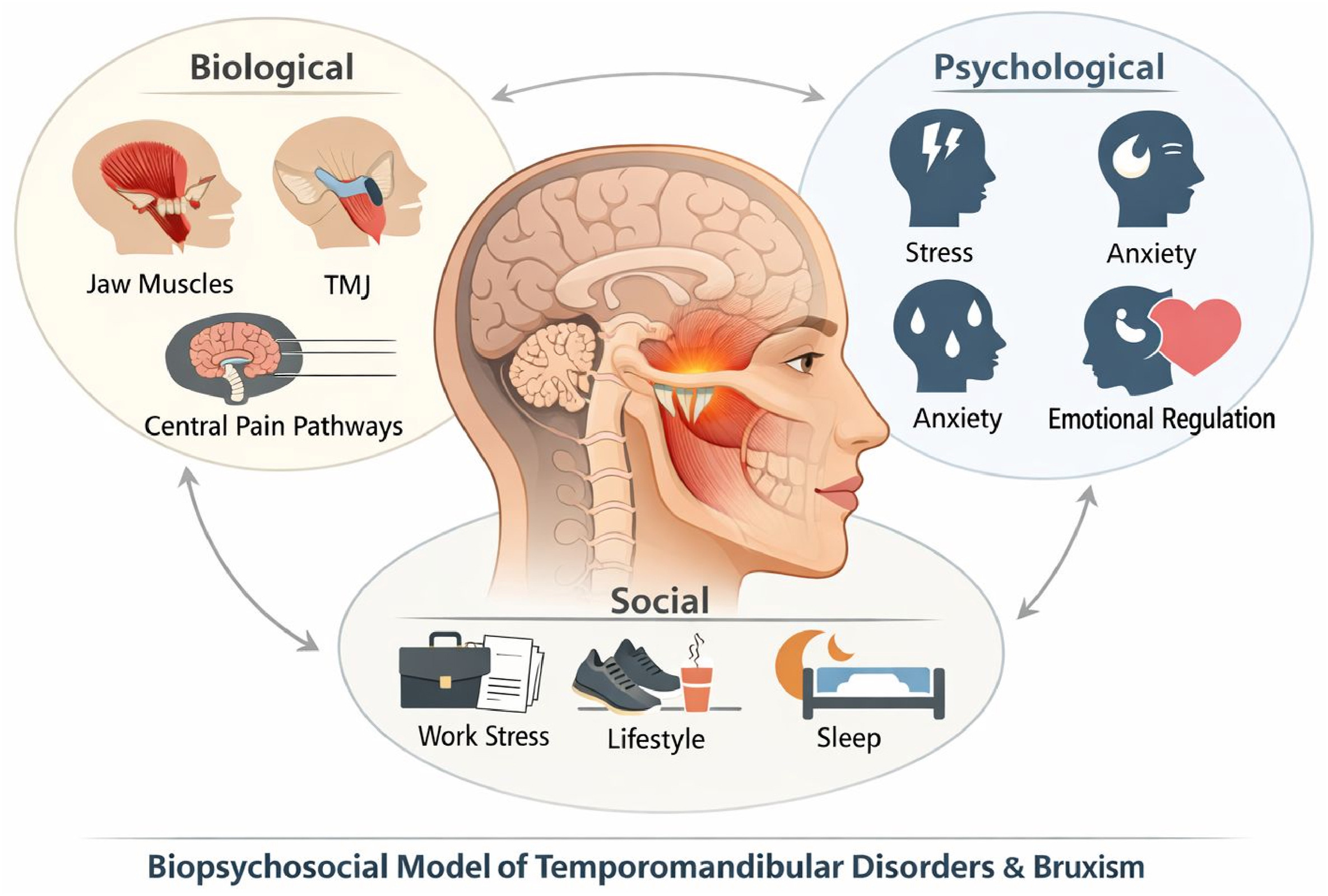
I'll commonly see patients for TMJ-related pain, many of whom self-refer or come in asking about specific treatments. But TMD is rarely a surgical disease. Current thinking on the matter points to the biopsychosocial model as the framework for describing how it develops — the interaction of biological, psychological, and social factors that predispose someone to TMD, trigger an episode, and keep it going once it starts. For the large majority of patients, treatment will center on wrestling with the initiating factors: stress management, postural correction, or downregulating the brain's pain pathways.
Enter orofacial pain (OFP) specialists. In 2020, this clinical discipline gained recognition as the twelfth dental specialty, alongside oral medicine1 in the same year. A select number of dentists had been practicing in this space for decades, through postgraduate fellowships, advanced continuing education, and/or board certification through the American Board of Orofacial Pain (ABOP). But without formal specialty status, they couldn't be recognized or advertised the way an orthodontist or surgeon could, for example.
OFP dentists are generally non-proceduralists, instead flexing their expertise through diagnosis, medication management, and directing physical and behavioral therapy. While they often manage things like headache or pain originating from nerve dysfunction, disorders of the TMJ and its supporting muscles are a major part of their practice. Initial therapies often include habit modification (frequently through bite splints), short-term oral medications, or muscle release through massage, physical therapy, or therapeutic injections.2 In select cases, behavioral approaches like CBT target the stress-pain cycle, which can be helpful for patients whose pain is being sustained by catastrophizing or psychological factors.
Oral and maxillofacial surgeons, meanwhile, are usually best reserved for a narrower group: patients whose pain is a result of a physical impingement of movement or a structural breakdown of the joint components, and who — critically — haven't responded to more conservative care. Even within that group, we start small. Many cases that reach me are managed by flushing out the joint and breaking up adhesions rather than opening it up.3 True open joint surgery is reserved for a smaller group still.
Where surgery still fits
None of this is to say I don't treat non-surgical patients; I do, and often. But I think bringing awareness to this allied specialty is an important service, both to patients and the general practitioners who may not be aware of its existence. I refer a number of patients to my colleagues in the field, and that pattern runs both ways.
A patient who wakes up with a sore jaw most mornings but shows nothing on imaging benefits more from the services of an OFP doctor before we even mention surgery. Likewise, someone frustrated by painful joint clicking and limited opening who isn't seeing success with a night guard is more likely to benefit from my toolkit as a surgeon.
That back-and-forth is really the point: knowing who to see first saves most patients from ever needing a surgeon, and it saves the ones who do need one from spending years finding their way there.
—
1 Oral medicine specialists work in a sometimes overlapping but broader scope. Another non-procedural form of practice, they cover oral diseases that fall outside of the tooth realm: mucosal lesions (sores, rashes, textural changes), salivary disturbances, or oral manifestations of systemic diseases. Some of these conditions are painful and could fall to either specialty. Both are young, and outside of academic institutions, many practicing dentists, and very nearly all clinicians outside of dentistry, are unfamiliar with them even existing.
2 Including Botox, which, to be clear, does have legitimate use in this area.
3 Said arthrocentesis, or joint lavage, isn't 'surgery' per se, but it is a procedure that traverses multiple tissue planes and demands a working knowledge of surgical anatomy.
Recent Posts

The ultimate post-surgery eating guide
PRF: blood-based treatment to speed healing after surgery